Design Custom 8oz Paper Cups Instantly in Canva
When you are launching a specialty coffee cart, a small bakery, or a catering service, the details matter. One of the most visible details is your servingware. However, hiring a graphic designer to mock up a simple paper cup design can be expensive and time-consuming. This is where the 8oz Paper Cup Canva Template changes the game. It provides a pre-formatted, scalable layout specifically designed for standard 8-ounce cups, allowing you to visualize and finalize your branding assets before you ever hit the print button.
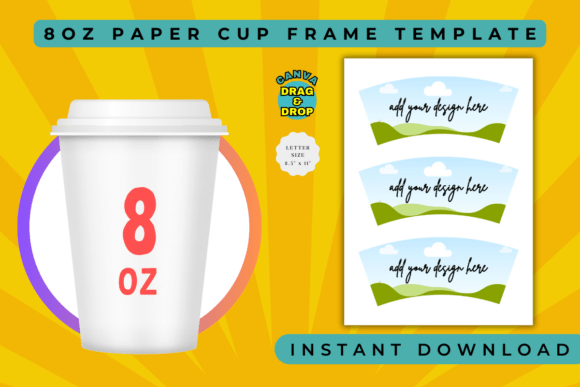
It is important to clarify exactly what this product is. THIS IS A DIGITAL ITEM. NO PRINTED ITEM WILL BE SHIPPED TO YOUR HOME. You are purchasing access to a sophisticated design file that you can edit within the Canva platform. Think of it as a digital mold for your visual identity. The template usually comes as a dieline—a flat representation of the cup’s surface—showing exactly where the seam will meet and how the design wraps around the vessel. This eliminates the guesswork of sizing and ensures that your logo or pattern prints exactly where you intend it to be.
The Anatomy of an 8oz Paper Cup Template
Visually, an 8oz paper cup is distinct. It is smaller than a standard water cooler cup, usually featuring a slight taper that narrows at the bottom. A good template accounts for this geometry. The design layout often resembles a trapezoid with curved edges, representing the printable surface area. When you open this digital asset, you will typically find designated layers for the background color, the main graphic or logo, and any secondary information like a website URL or tagline.
The appeal of using a Canva-based template lies in its accessibility. Canva is known for its user-friendly interface, and these templates leverage that. You are not dealing with complex vector paths in Adobe Illustrator. Instead, you are working with a drag-and-drop interface. The template might include placeholder text in a modern typography style, but the real value is the frame itself. It acts as a boundary box, ensuring your brand identity elements don't get lost in the fold or bleed off the edge during manufacturing.
Personality and Style Versatility
Because this is a template, the "personality" is entirely up to you. The file acts as a blank canvas. However, the structure of the template influences the final look. For example, because the surface area of an 8oz cup is relatively small compared to a 16oz cup, the design requires a certain economy of space. This naturally pushes the design toward minimalism or bold, display font usage. You cannot fit a paragraph of text on an 8oz cup; you need a strong logo or a distinct pattern.
These templates are perfect for content creators who need to mock up a product for a photo shoot or a social media post. If you are a blogger promoting a "morning coffee" aesthetic, you can edit the template to feature your personal brand colors and a handwritten font, take a screenshot, and use it in your content without ever manufacturing a real cup. This flexibility makes it a valuable tool for visual storytelling.
Practical Applications for Small Businesses
For entrepreneurs, the utility of an 8oz Paper Cup Canva Template extends beyond just the cup itself. It serves as a key component in a larger packaging design strategy. Here is how different professionals can utilize this asset:
- Pop-up Cafes and Food Trucks: Before ordering a bulk shipment of 10,000 cups, you can use the template to create a digital proof. You can test different color combinations to see which one pops the most against a stainless-steel espresso machine or a wooden counter.
- Wedding Planners and Event Coordinators: For an 8oz cup often used for desserts or espresso, you can customize the template with the couple's monogram. This allows you to send a digital preview to the client for approval instantly.
- Graphic Designers: If you are building a brand identity package for a client, including a mockup of their disposable cups adds immense value. It shows you have thought about their physical presence, not just their web design.
- Social Media Managers: Create seasonal variations. One week, the cup features a spooky Halloween font; the next, it features a festive red and green palette. This keeps content fresh without physical waste.
Design Strategy: Fonts, Colors, and Hierarchy
Designing for a curved, small surface requires a different approach than designing for a flat social media graphic. When working with your 8oz Paper Cup Canva Template, visual hierarchy is paramount. You generally have room for one focal point.
Choosing the Right Typeface: Since space is limited, your font choice carries the weight of your communication. A serif font can lend an air of tradition and quality, perfect for a high-end tea house or a classic patisserie. Conversely, a clean sans serif font offers a modern, hygienic feel suitable for a juice bar or a contemporary coffee shop. Avoid overly complex script fonts or decorative fonts for the main business name, as legibility decreases when printed on a small, curved object. However, a handwritten font can work beautifully for a "Thank You" message or a small tagline near the rim of the cup.
Color and Contrast: Paper absorbs ink differently than screens. When using the template, be mindful of contrast. If you are using a kraft (brown) paper cup, bright colors will appear muted. If you are using a white cup, you have more freedom with your palette. The template allows you to experiment with these variables. You can place a premium font logo on the cup and toggle the background color between white, black, and kraft to see which combination offers the best readability.
Evaluating and Using Your Digital Asset
When you acquire this template, you are gaining a design asset that saves time. However, there are a few practical considerations to keep in mind to ensure the best results.
Scalability and Resolution: Canva works with raster and vector elements. Ensure that any logo you upload into the template is a high-resolution PNG or an SVG file. While the template itself is high-resolution and scalable, the images you put into it must also be sharp. Blurry text or pixelated logos will ruin the professional look of the final product.
Commercial Usage: Since this is a commercial font and template environment, you generally have the rights to use the designs you create for your business. However, you cannot resell the blank template itself. The value lies in the customization. You are taking the base layout and transforming it into a unique piece of packaging design.
Testing the Layout: Do not just design on the screen; print it out. If you have a standard printer, print the flat dieline on a piece of paper. Cut it out and tape it around a standard 8oz cup (like a Dixie cup). This physical test is crucial. It helps you see if the text is readable from a distance and if the placement feels natural in the hand. Sometimes, a design that looks centered on the digital screen might feel too low when held.
Streamlining Your Creative Workflow
The greatest advantage of using an 8oz Paper Cup Canva Template is the reduction of friction in the design process. For a small business owner who is not a trained designer, opening a blank Adobe Illustrator artboard is intimidating. Canva democratizes this process. The template provides the constraints—the "rules" of the cup—so you can focus on the creativity.
It bridges the gap between an idea and a tangible product. By using these frames templates, you can quickly iterate on ideas. You might start with a vintage aesthetic and realize it doesn't fit your modern shop vibe. With a few clicks, you can swap it for a minimal layout using a modern typography stack. This ability to pivot quickly is essential in today's fast-paced market.
Ultimately, this digital tool empowers you to take control of your visual presentation. Whether you are finalizing a product launch or simply creating a mockup for an investor pitch deck, having a realistic representation of your physical branding builds credibility. It shows that you pay attention to the details that define the customer experience, right down to the cup they hold in their hand.